Ask ten therapists how they write session notes and you'll get ten answers. Some kept the template from grad school. Some inherited the house style at their first job and never once questioned it. And some just wing it, a little differently every time.
That last one feels like freedom. Right up until it isn't. You're sitting in supervision, or filling out an insurance form, or a lawyer's office has requested records, and suddenly a scattered pile of notes is exactly the wrong thing to be holding.
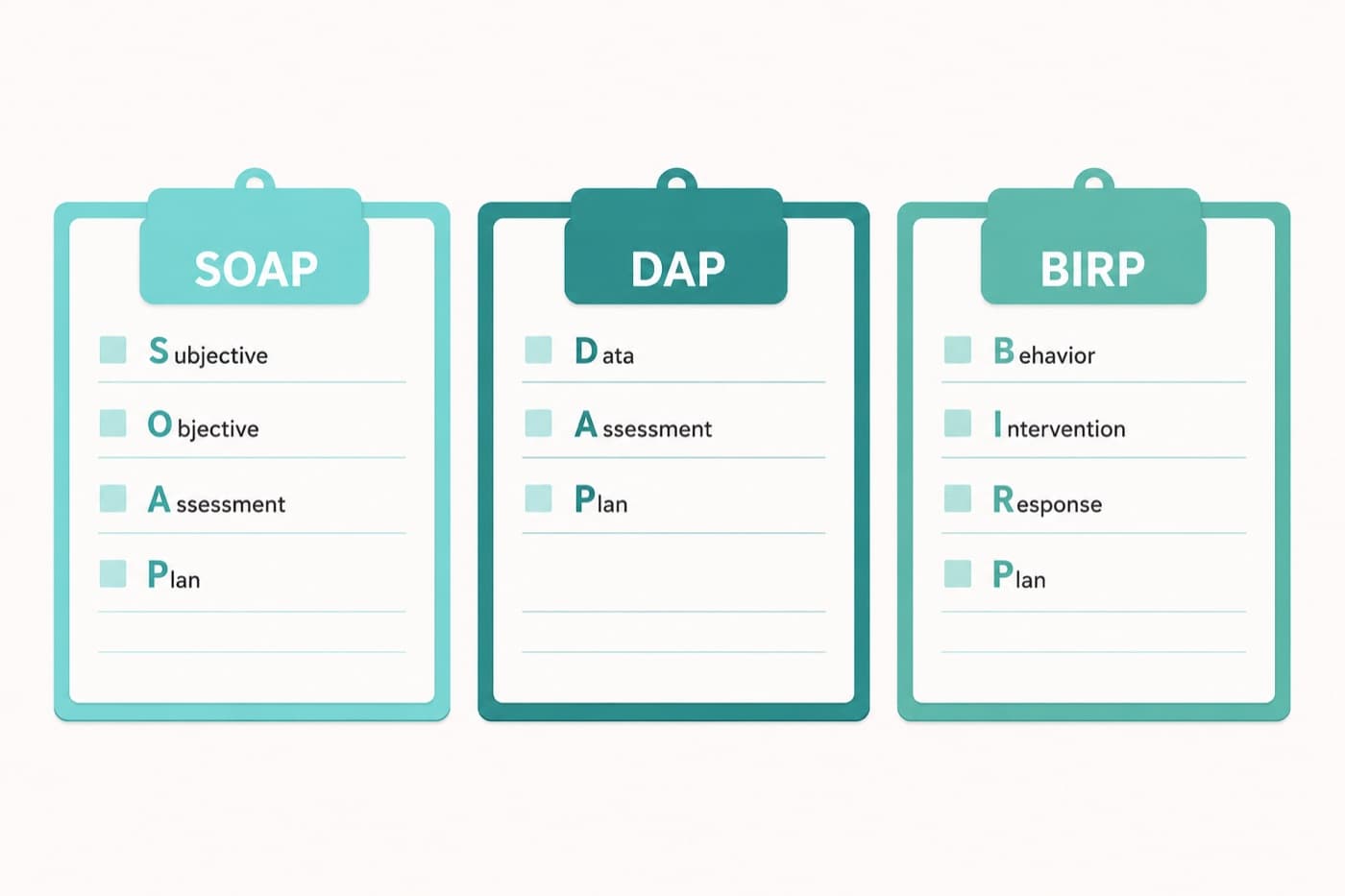
Three formats show up again and again: SOAP, DAP, and BIRP. Each is structured. Each suits a different setting and a slightly different way of thinking about the work. So let's walk through all three, figure out which one fits which kind of practice, and see what they actually look like on the page.
Why the Template Even Matters
Free-form notes feel faster in the moment. The catch is what they cost you later.
Three costs, really. You go back to a note from six weeks ago and can't find the one detail you needed, because it's buried in a paragraph somewhere. A colleague reads your notes in supervision and can't follow them. An insurance claim or a legal request lands, and an inconsistent record turns a five-minute task into a whole afternoon.
A structure fixes all of that quietly. You write the same shape every time, so the format stops being a decision you make session by session. And when you flip back through eight weeks of a client's work, you can track progress category by category, because everything is always in the same spot. That's the real point. Picking a format and sticking to it matters as much as what you write inside it.
What Is a SOAP Note?
The short version
SOAP stands for Subjective, Objective, Assessment, Plan. It splits what the client tells you from what you observe, then adds your clinical read and the next step. It comes from medicine, which is why it fits psychiatry, multidisciplinary teams, and anywhere insurance is involved.
Here's how it breaks down, and when to reach for it.
Subjective (S): The client's own words. Their complaints, what's been hard, what happened over the past week. "I'm still having trouble falling asleep." "Things went better with my kid this week."
Objective (O): What you observed. Affect, rate of speech, appearance, whether there's any suicidal ideation, behavior. Scale scores where you have them, like a BDI or a HAM-A.
Assessment (A): Your clinical read. Diagnosis, where things stand, any shift in your formulation.
Plan (P): The next step. Homework, a medication adjustment if you're prescribing, what the next session focuses on.
SOAP shines for psychiatrists, for psychologists working inside a healthcare team, and for clinics that live with insurance paperwork. The structure is clear, and it travels well between people.
What Is a DAP Note?
DAP stands for Data, Assessment, Plan. Think of it as SOAP with the two front sections folded into one.
Data (D): Everything the client said and everything you noticed, together. No splitting subjective from objective. It all goes here.
Assessment (A): Your interpretation, formulation, progress.
Plan (P): The next step.
Why merge those first two? Because in a lot of therapy, the split just feels forced. Most of what you have to work with is the client's own account. Drawing a hard line between "what they said" and "what you saw" can be more bookkeeping than insight.
So for an independent CBT or psychodynamic therapist, DAP is usually the leanest option. Quick to write. Easy to read back months later.
When SOAP starts feeling like a chore
A CBT therapist in solo practice writes SOAP notes because that's what the training used. Every session she's splitting hairs: does 'client seemed anxious talking about work' go under Subjective or Objective? It's her read either way. After a month she switches to DAP, drops both into one Data block, and the friction disappears. Same information. Half the second-guessing.
What Is a BIRP Note?
BIRP stands for Behavior, Intervention, Response, Plan. It's the one that keeps you honest about what you did.
Behavior (B): The topic, behavior, or symptom the client brings in.
Intervention (I): What you did about it. The technique, the guidance, the interpretation.
Response (R): How the client took it. Did insight land? Was there resistance? Did something new open up?
Plan (P): Where the next session goes.
Notice the middle two. BIRP makes you name your intervention and then look, honestly, at whether it worked. That's gold when you're in training or under supervision, because it puts your clinical moves right on the page where a supervisor can actually see them. It fits EMDR work, structured CBT, and group therapy well too, where the intervention and the response really are the story.
SOAP vs. DAP vs. BIRP: A Side-by-Side
No format wins in the abstract. The right one is the one that matches how you actually work.
There's no best format in a vacuum — only the one that matches your setting.
Read that as a rough map, not a rule. Work in psychiatry, inside a team, or around insurance? SOAP is the safe pick. Independent, and you just want notes that are fast to write and easy to skim later? DAP will probably feel right. In supervision, or sharpening your intervention skills, or working with structured methods? BIRP earns its keep.
One more thing, and honestly it matters more than which acronym you land on. Commit to a template. Then leave it alone. The same shape for every client is what turns a six-month-old note from a puzzle back into something you can read at a glance.
How Do You Write a SOAP Note? A Worked Example
Enough theory. Here's a fictional note so you can see the shape on the page.
Client: M. Arslan, Session 12
S: Reports falling asleep faster. Was taking roughly 45 minutes to drop off in prior weeks, down to about 15 this week. Still following the CBT-I protocol. Work anxiety a little lower. Says he's "exploding less" with his wife.
O: Bright affect, regular speech. No suicidal or self-harm ideation. Beck Anxiety Inventory 22 last time, 16 this week.
A: Generalized anxiety disorder, trending toward improvement. Current plan is working.
P: Continue weekly 50-minute sessions. Next time: review the sleep log, reinforce relaxation exercises.
See how little of it is prose? That's the point. A good note is scannable, not literary.
The note a supervisor could actually use
A trainee brings a client to supervision but her notes are three paragraphs of narrative. The supervisor keeps asking, 'Okay, but what did you do, and what happened after?' The next week she switches to BIRP. Now the Intervention and Response lines answer that question before it's asked, and supervision moves from decoding notes to discussing the actual work.
What You Actually Get From Sticking to One
A template isn't a cage. It's a habit that does quiet work on your behalf.
The right one saves you a couple of minutes after every session, and that adds up fast. It turns "where did I write that" into a two-second scan instead of a slow reread. It makes your notes easier to hand to a supervisor, steadier to defend if an insurance or legal review comes knocking, and simple to skim for progress across a full course of treatment. The magic was never in whether the letters spell SOAP or DAP. It's in writing the same way, every single time.
A Quick Checklist
Rethinking how you write notes? This is a fair place to start:
- You've picked one primary format and know why it fits your work.
- You use the same template for every client, not a different one each session.
- Each section stays in its lane (observations don't wander into Assessment).
- Notes are scannable, not narrative paragraphs.
- Scale scores and dates go in a consistent spot every time.
- Notes are written soon after the session, while it's fresh.
- Your tool supports SOAP, DAP, BIRP, and a custom option, so you're not locked in.
- Records are encrypted and access-controlled, not sitting in a shared file.
Want more on the writing itself? Our guide on how to write clear session notes goes deeper on the craft. If you're a trainee logging hours, tracking supervision hours pairs well with a BIRP habit. And the data side matters just as much as the format, which is where GDPR and data-protection basics for therapists come in.
Manage Your Session Notes With Calemio
Calemio supports SOAP, DAP, BIRP, and your own custom templates, so you keep whatever structure fits your practice without switching tools. Every note is locked at the session level, encrypted end to end, and never used for AI training under any circumstances. Start a free trial here.
Frequently Asked Questions
What is the difference between SOAP, DAP, and BIRP notes?
All three are structured session note formats. SOAP (Subjective, Objective, Assessment, Plan) separates the client's report from your observations and comes from medicine. DAP (Data, Assessment, Plan) merges subjective and objective into one 'Data' section for faster writing. BIRP (Behavior, Intervention, Response, Plan) centers on the intervention you applied and how the client responded to it.
Which session note template is best for therapists?
There is no single best format, only the one that fits your setting. SOAP suits psychiatrists, multidisciplinary teams, and insurance-heavy work. DAP is efficient for independent psychotherapists who want fast, readable notes. BIRP is ideal if you are in supervision or want to track your intervention skills.
Why should I use a structured note template instead of free-form notes?
Free-form notes feel faster but make it harder to find information later, harder to share in supervision, and risky if an insurance claim or legal request arrives. A structured template lets you write consistently without thinking about format and track client progress category by category over time.
Is DAP just a shorter version of SOAP?
Essentially, yes. DAP combines SOAP's Subjective and Objective sections into a single Data section, keeping Assessment and Plan the same. In psychotherapy the distinction between subjective and objective often feels artificial, since most of the data is the client's own account, which is why many independent therapists prefer DAP.
Can I switch between note templates for different clients?
You can, but it is usually better to commit to one template and use it consistently. Using the same format for every client makes your notes far easier to compare and review months later. If your needs differ by case, choose a tool that supports SOAP, DAP, BIRP, and custom templates so you keep flexibility without losing consistency.
Related articles



Try Calemio for free
Encrypted, compliant and simple. Built for independent therapists and clinics.
Start free